Most businesses meet AI agents the same way. Someone builds a ChatGPT helper over a weekend. It answers questions well. Then it needs to update the CRM or raise an invoice, and it hits a wall.
That gap is what AI agent development services exist to close. They turn a clever demo into software that does real work inside your systems. It’s also where a lot of money gets wasted. Gartner expects over 40% of agentic AI projects to be cancelled by the end of 2027.
This Weavelinx guide covers what a partner should deliver and what it costs. It also shows how to spot a rebranded chatbot.
What Are AI Agent Development Services?
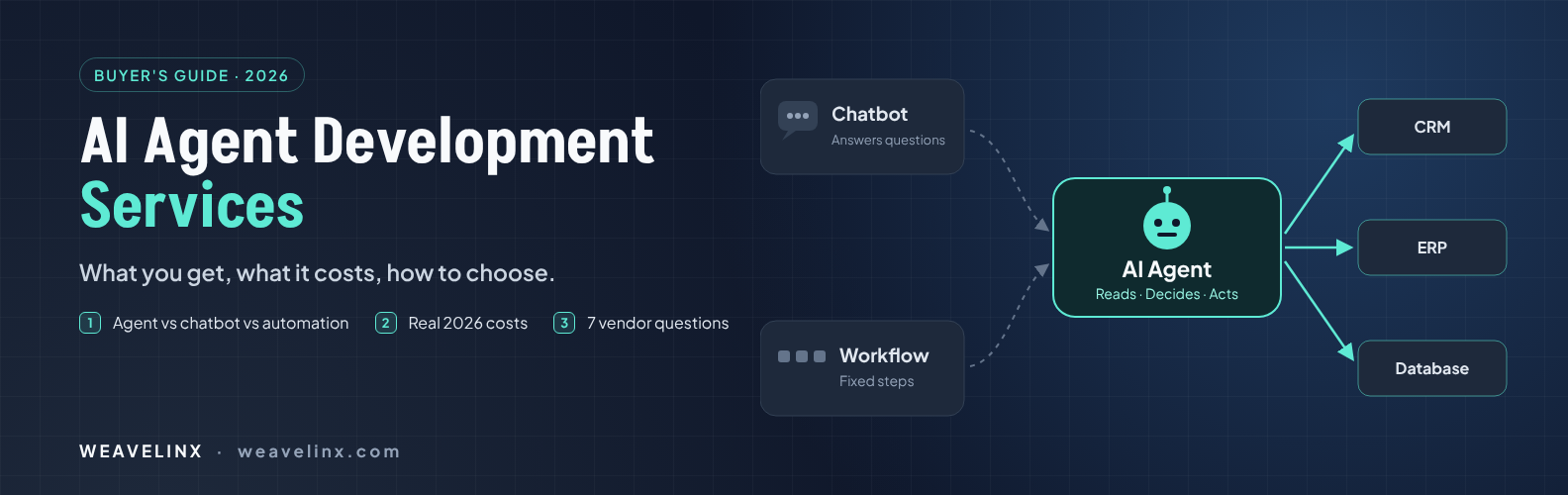
AI agent development services build software that reads information, decides the next step and takes action inside your business tools. The action part is what separates an agent from a chatbot.
Here’s how the three options people mix up actually differ:
| Chatbot | Workflow automation | AI agent | |
| What it does | Answers questions in a chat window | Runs fixed steps when a trigger fires | Reads messy input, picks steps, uses tools |
| Best for | FAQs | Repetitive, rule-based jobs | Jobs that need judgement |
| Example | “What are your opening hours?” | New lead → CRM → WhatsApp reply | Reads a supplier email, matches it to a PO, flags a price mismatch for approval |
Anthropic, which makes the Claude models, draws the same line. In its guide to building effective agents, it calls fixed code paths workflows and model-directed ones agents. Its advice is to start with the simplest option and add complexity only when it clearly helps.
Do You Actually Need an AI Agent? The 4-Question Test
You need an agent only when a task needs judgement, happens often and touches systems the agent can reach. Otherwise, plain automation is cheaper and more predictable.
Answer these four questions honestly:
- Is the input unstructured? Emails, PDFs, chat messages and scanned forms suit an agent. Clean form data suits a workflow.
- Does it happen often? A task done 20 times a day pays back far faster than one done twice a month.
- Can the agent reach your data? Your CRM, ERP or database needs an API. If key data sits in a spreadsheet nobody updates, fix that first.
- Can a person check risky actions? Refunds, deletions and customer messages should wait for approval, at least for the first few months.
Three or four “yes” answers: an agent is worth scoping. One or two: start with workflow automation instead.
Builders agree. In recent Reddit r/AI_Agents threads, developers admit spending weeks on agents that a cheap monthly workflow could have handled.
What Should a Development Partner Deliver?
A complete engagement covers six things: scoping, data access, agent logic, guardrails, testing and monitoring after launch. If a quote skips any of them, ask why.
| Stage | What you should get | Why it matters |
| 1. Scoping | One process chosen, its current cost measured, one success metric agreed | Stops you building the wrong thing |
| 2. Data and integration | API links to your CRM, ERP or database; search over your own documents (RAG) | The agent works on your real data, not a demo |
| 3. Agent logic | Prompts, tools and a model chosen per step | Controls both accuracy and running cost |
| 4. Guardrails | Approval steps, role-based access, spend limits, audit logs | Prevents costly mistakes |
| 5. Testing | Checks on real examples for accuracy, speed and cost | Databricks reports teams using evaluation tools get about 6x more AI projects into production |
| 6. Monitoring | Logs, alerts and regular tuning | Agents drift as your data and processes change |
Insist on stage 5 before launch. A demo that worked on ten hand-picked examples proves very little.
Where Do AI Agents Work Best for Growing Businesses?
Agents earn their cost on frequent tasks that mix reading, deciding and updating a system. These are the most common first projects:
- Support triage. Answers routine tickets from your help docs and routes the rest with full context.
- Lead qualification. Reads enquiries from portals, your website and WhatsApp, scores them and logs them in the CRM.
- Document checks. Reads invoices or purchase orders, compares them with your records and flags mismatches.
- Internal knowledge assistant. Answers staff questions from policies and SOPs, citing the source.
- Ops reporting. Pulls numbers from several tools and drafts the weekly summary.
Real agents are narrower than the hype. A study of agents in production found 68% run ten steps or fewer before a person steps in. That isn’t a weakness. It’s how safe systems are built.
AI Consultation
Not sure whether you need an agent or a workflow?
Send us the process. We will tell you which fits, and say so if neither is worth building yet.
How Much Does AI Agent Development Cost?
Cost depends mostly on integrations and oversight, not on the AI model. The more systems an agent touches, the more it costs. Global vendor guides in 2026 quote roughly these bands:
| Type | Build cost (global quotes) | Timeline | Monthly running cost |
| Low-code agent (n8n, Voiceflow) | 5,000–15,000 | 2–4 weeks | 300–800 |
| Custom single-purpose agent | 25,000–100,000 | 6–12 weeks | 500–3,000 |
| Multi-agent system | 100,000–400,000+ | 3–6 months | 2,000–10,000+ |
Source: Arka Softwares cost guide, 2026. Indian teams usually quote well below these USD bands. For rupee context, see our application development cost guide for India.
Two costs buyers often miss:
- Running costs are monthly. Model usage, hosting, monitoring and tuning never stop. First-year total cost often lands 40–80% above the build quote.
- Guardrails take real budget. In regulated work, approval steps and audit logs can approach half the project.
The cheapest safe path: prove one agent on one process first. Our guide to what an MVP in software development really is shows how to test value first.
How to Choose an AI Agent Development Company
Pick a partner who scopes before quoting, tests on your real data and leaves you owning the code. Gartner estimates only about 130 of the thousands of “agentic AI” vendors are genuine. It calls the rest “agent washing”: chatbots and old automation with a new label.
Ask every shortlisted vendor these seven questions:
- Will you tell us if we don’t need an agent?
- How will you measure accuracy before launch?
- Which actions will need human approval?
- What will it cost per month to run, at our volume?
- Where does our data go, and can it stay on our servers?
- Do we own the code, prompts and test data?
- Do you use open standards like Model Context Protocol (MCP), so we can switch models later?
Red flags to walk away from:
- A multi-agent proposal in the first call.
- A demo that only ever runs on sample data, never yours.
- A build-only quote with no running costs.
- One model locked in “because it’s the best.”
How Weavelinx Builds AI Agents
We build agents that work inside your CRM, ERP or database. First, we check whether AI is the right tool at all. Not every problem needs a language model.
Our AI agent development services follow four steps:
- Use-case scoping. We find where AI adds value and where it only adds complexity.
- Prototype and evaluate. We test on your real data and measure accuracy, speed and cost first.
- Production build. Error handling, logging, rate limits and a fallback when the model underperforms.
- Deploy and iterate. An evaluation framework lets you track quality over time.
We pick the model to fit the job: OpenAI, Anthropic, Gemini, Mistral or local models. When data must stay private, we use Azure OpenAI or self-hosted models through Ollama. For document Q&A, well-structured content can reach 85–95% accuracy on in-scope questions. We build the test set, so you can check that yourself.
Sometimes the honest answer is plain automation. Our Workspace Automation Suite automated 11 recurring workflows across Slack, Google Workspace, Notion and a custom CRM. It saves a 12-person ops team 40 hours a week.
Building a software product rather than buying an agent? Read how to make SaaS application development agent-ready.
Frequently Asked Questions
What do AI agent development services include?
They cover six stages: choosing one process to automate, connecting your data, building the agent’s logic, adding guardrails such as approval steps, testing on real examples, and monitoring after launch.
How much does it cost to build an AI agent?
Global 2026 quotes run 5,000–15,000 for a low-code agent and 25,000–100,000 for a custom agent, plus 300–3,000 a month to run. Indian teams usually quote lower. Always ask for first-year cost, not just build cost.
How long does it take to develop an AI agent?
A low-code agent takes 2–4 weeks. A custom agent with real integrations takes 6–12 weeks. Multi-agent systems take 3–6 months. A good partner shows a working prototype on your data early.
What is the difference between an AI agent and a chatbot?
A chatbot answers questions. An AI agent takes action. It can read data from your systems, decide what to do and update a record, send an approval request or trigger a workflow.
Is my business data safe if the agent uses OpenAI or Claude?
Business APIs from major providers don’t train on your inputs by default, but check each provider’s terms. For stricter needs, agents can run on Azure OpenAI or on self-hosted models, so data stays on your infrastructure.
Start With One Process, Not a Platform
In 1966, researchers at SRI began building Shakey, the first robot that could reason about its own actions. It took six years to teach it to push boxes around a few rooms.
Sixty years later, agents finally do useful work in business software. The businesses that benefit won’t be the ones with the most agents. They’ll be the ones that pick one costly process, measure it, and automate it with the right tool.
AI Agent Development
Have a process that eats hours every week?
Tell us what it is. We will come back with a clear scope, an honest timeline, and a straight answer on whether you need an agent at all.