Most failed startups do not run out of code. They run out of customers. CB Insights puts “no market need” as the top reason startups fail, at 42% — ahead of running out of cash.
The real question is not can we build this? It is does anyone want it? An MVP answers that. Understanding what is MVP in software development is the difference between a six-week test and a six-month guess.
This guide covers what an MVP is, what to cut, what it costs, and how to know if it worked. At Weavelinx, we scope MVPs around one core job and ship fast.
What Does MVP Mean in Software Development?
MVP stands for Minimum Viable Product. It is the smallest working version of your product that solves one real problem for real users, so you can learn whether the idea is worth building further.
Eric Ries popularised the term in The Lean Startup, defining it as the version that collects “the maximum amount of validated learning about customers with the least effort.” He did not coin it, though — Frank Robinson defined MVP in 2001. Plenty of guides get this wrong.
| Element | What it means in practice |
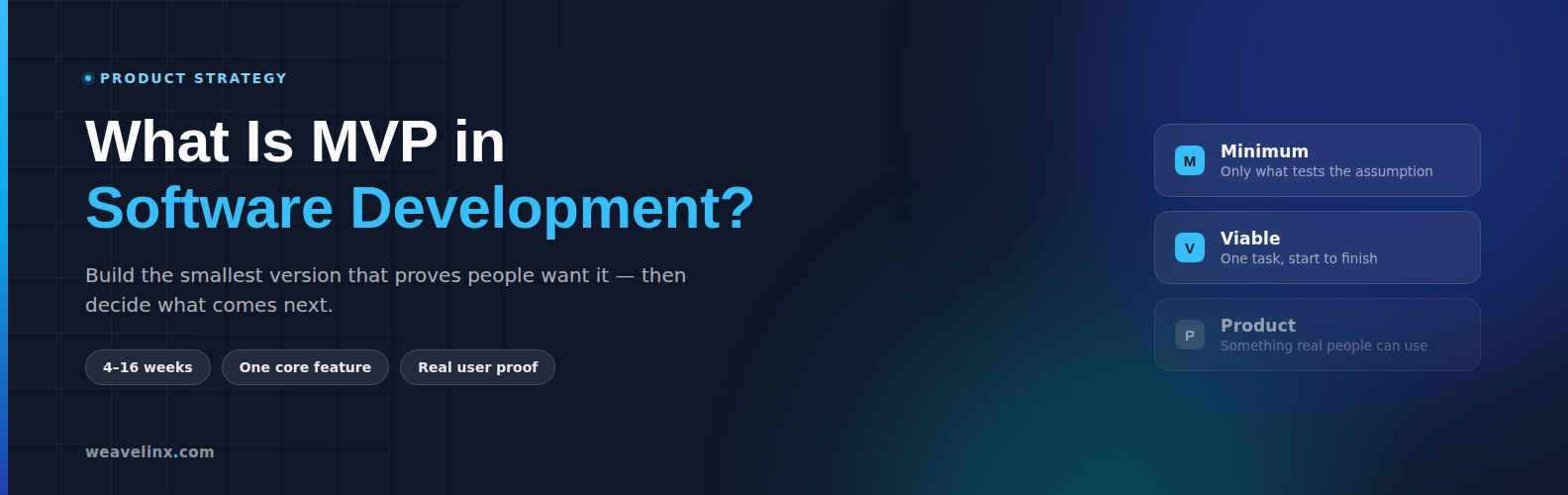
| Minimum | Only the features needed to test your main assumption. |
| Viable | It actually works. One complete task, start to finish. |
| Product | Something real people can use — not a mockup or a slide. |
That middle word causes the most damage. Minimum does not mean broken. Half a working feature is not an MVP. It is a bug.
MVP vs MVC: Not the Same Thing
People search for both, so let’s clear it up. MVP is a business idea. MVC is a code pattern.
- MVP (Minimum Viable Product) decides what you build first.
- MVC (Model-View-Controller) decides how your code is organised.
You can build an MVP using MVC. They solve different problems.
Where an MVP Fits in the Software Development Lifecycle
An MVP is not the first step. Two stages usually come first, each removing a different risk.
| Stage | Question it answers | Who sees it | Typical time |
| Proof of Concept | Can we build this at all? | Internal tech team | Days to 2 weeks |
| Prototype | Does the flow make sense? | Stakeholders, testers | 1–3 weeks |
| MVP | Does anyone actually want it? | Real users | 4–16 weeks |
| MMP | Is it ready to sell widely? | The wider market | After MVP feedback |
A proof of concept kills technical risk. A prototype fixes the experience. Only the MVP tests the market.
Why Build an MVP First?
Because building the wrong thing is the most expensive mistake in software. The research on why startups fail is blunt about the habits behind it:
- 65% never spoke to a customer before building.
- 89% never tested whether anyone would pay.
- 78% interviewed fewer than 15 people.
Founders who validate properly cut their failure rate from 42% to under 15%, reach revenue 40% faster, and raise money 2–3x more successfully. Google Trends also shows searches for “minimum viable product” hit a five-year high in May 2026, after four flat years.
MVP Scoping
Not sure what belongs in version one?
Book a free discovery call and we’ll help you cut your feature list down to what actually needs testing.
How to Build an MVP in 6 Steps
- Name the problem. One sentence. If you cannot write it, you are not ready to build.
- Pick your core feature. What is the one thing this product must do? The rest is version two.
- Prototype it first. Test the flow in Figma before anyone writes code.
- Build one complete workflow. A user should finish a real task, start to finish.
- Launch to about 50 people. Not 50,000. You need honest feedback, not scale.
- Measure, then decide. Do they return? Will they pay? Build feature two only after you know.
This is the same waste-cutting logic behind lean software development — build small, learn fast, skip work nobody needed.
How Long Does an MVP Take and What Does It Cost?
Most MVPs take 4 to 16 weeks:
| Phase | Time |
| Discovery and scoping | 1–2 weeks |
| UI/UX prototyping | 1–3 weeks |
| Core development | 2–8 weeks |
| Testing and launch | 1–3 weeks |
Cost is where founders get confused. Quotes range from $15,000 to $300,000 for what sounds like the same thing. Both numbers are real.
| MVP type | Cost (USD) | Cost (INR) |
| Landing page or waitlist test | $600 – $2,000 | ₹50,000 – ₹1.5 lakh |
| Single-feature MVP | $2,400 – $6,000 | ₹2 – 5 lakh |
| Standard web or mobile MVP | $6,000 – $14,400 | ₹5 – 12 lakh |
| Complex or regulated build | $14,400 – $30,000+ | ₹12 – 25 lakh+ |
The spread comes down to three things: how many features you include, how many systems you connect to, and where your team sits. A fintech MVP with compliance rules costs far more than a booking tool. Rates in India sit well below US and European rates, which is why outsourcing your build often makes the numbers work.
One warning: teams typically underestimate MVP costs by 30–40%.
5 Mistakes That Kill MVPs
These come from founders describing real projects, not theory.
1. Feature bloat. One dev shop described a founder with a 47-page requirements document and a $40,000 budget. Asked to name the one core job, he could not. Cut to a single workflow, it launched in 7 weeks instead of 6 months and got 200 signups in week one.
2. Building for users you do not have. The same shop compared two real projects:
| Approach | Cost | Time | Result |
| Microservices and Kubernetes | $120,000 | 5 months | 31 signups, then pivoted |
| Basic Next.js app on Vercel | $25,000 | 6 weeks | 500 users month one, still running at 5,000 |
3. Engineering for its own sake. Founders spend two weeks building custom login when Firebase Authentication takes two hours. Your MVP does not need message queues yet.
4. Shipping an AI prototype as production. A fintech founder built her product entirely with AI tools, got a bank interested, then hired a team to make it production-ready. The quote was 300+ hours — roughly the cost of building it properly from scratch. The server also went live with an open port and a default password. Ransomware wiped it.
AI tools are useful for testing an idea in days. They are not a substitute for someone who can read the code you ship.
5. No success criteria. If you did not define “working” before launch, you cannot tell success from noise.
Prototype Review
Built a prototype with AI and unsure what happens next?
Our custom software development team will review it and tell you honestly what needs rebuilding.
How to Know If Your MVP Worked
Set these targets before you launch:
| Metric | Consumer product | B2B product |
| Activation rate | 40%+ | 60%+ |
| Week-4 retention | 20%+ | 60%+ |
| Time to first value | Under 5 minutes | Under 24 hours |
Persevere when usage grows and people return unprompted. Pivot when your core assumption is clearly wrong — not just because growth feels slow.
When an MVP Is the Wrong Choice
Most guides skip this. An MVP is not always right:
- Crowded markets. Against ten polished competitors, a rough version just loses.
- Reputation risk. A weak first impression sticks, especially with enterprise buyers.
- Regulated sectors. Healthcare and finance have compliance floors you cannot ship below.
Here, a Minimum Lovable Product — smaller in scope but properly finished — is the better call.
MVP Examples That Started Small
- Dropbox had no product. Just a three-minute video. Signups jumped 5x overnight.
- Uber launched as an iPhone-only SMS service in one city. It now runs about 19 million trips a day.
- Zappos had no inventory. The founder photographed shoes in local shops, then bought each pair after someone ordered.
- Instagram began as Burbn, a cluttered check-in app. The founders cut everything except photos, comments, and likes.
Every one of them tested demand before building the real thing.
We work the same way. DeskBilling, our desktop billing software, started as a narrow tool for one job.
FAQs
What does MVP stand for in software development?
MVP stands for Minimum Viable Product. It is the simplest working version of a product, built to test whether people want it before you invest in a full build.
What is the difference between an MVP and a prototype?
A prototype is a clickable design showing how something would work. An MVP is working software real users can use. Prototypes test the experience; MVPs test the market.
How much does an MVP cost in India?
Most MVPs in India cost ₹2 lakh to ₹12 lakh, depending on features and integrations. Landing-page tests start near ₹50,000. Complex builds run higher.
Can I build an MVP without writing code?
Yes. Landing pages, waitlists, and no-code tools validate demand well. Once real users and real data arrive, most products need proper engineering underneath.
How many features should an MVP have?
One core feature that solves one problem, completely. If you cannot name that feature, your scope is not ready.
Ready to Build Your MVP?
You do not need a big budget or a big team. You need a clear problem, one core feature, and a team that will tell you what to cut.
That is how we work: scope tightly, ship in weeks, and build so version two does not mean starting over.
Book a free discovery call and let’s map out what your version one should include.