A project billed monthly, with no fixed finish date, has no reason to end.
That explains most outsourcing horror stories. Not bad developers. Not distance. Just a contract that pays the same whether work ships in June or December.
The software development outsourcing process stops that. It runs from your first decision to the day the engagement ends. At Weavelinx we run it weekly. Here is each step, and where projects go wrong.
What Is the Software Development Outsourcing Process?
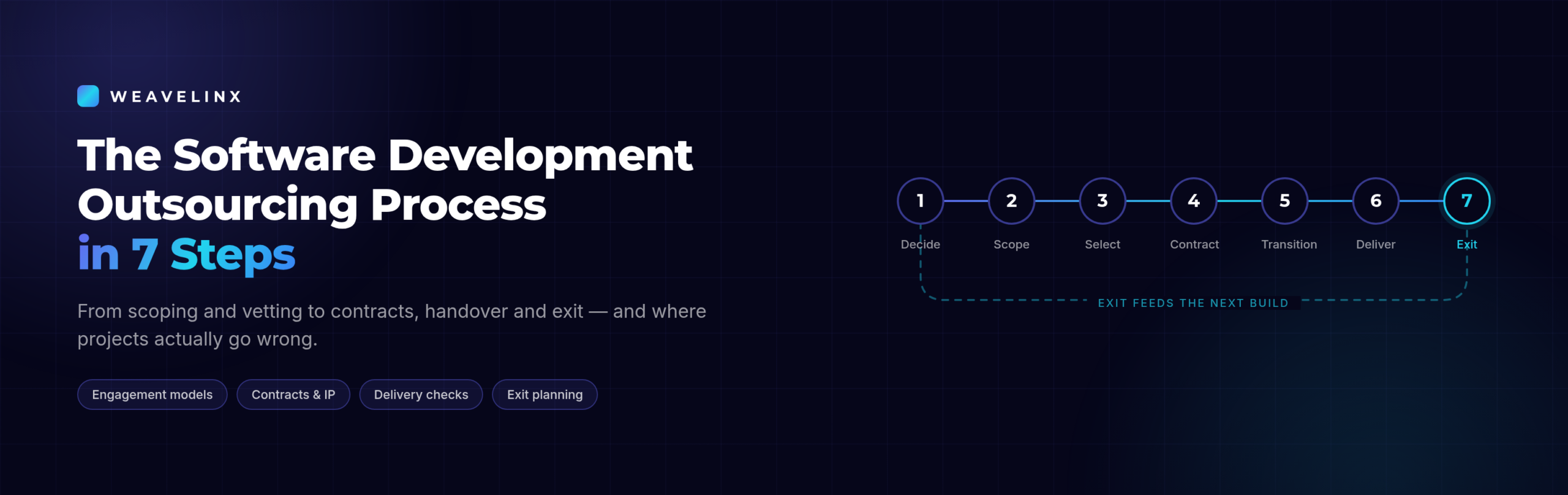
The software development outsourcing process is the sequence a company follows to hand a build to an external team. It covers seven stages: deciding to outsource, defining scope, choosing a model and partner, contracting, transition, delivery management, and exit. Each stage prevents a specific, common failure.
The seven steps, in order:
- Decide whether to outsource
- Write the scope before you talk to vendors
- Pick the engagement model, then the partner
- Get the contract right
- Run the first 30 days properly
- Manage delivery with real checks
- Plan the exit before you need it
Most guides stop at step four. Steps five to seven are where projects are won or quietly lost.
Research from ISG finds that 92% of the world’s 2,000 largest companies hold IT outsourcing contracts.
Outsourcing Process vs BPO: What’s the Difference?
BPO hands over a repeating operation: support desks, payroll, claims processing.
Software outsourcing hands over a build, with a scope, a launch date, and a codebase somebody owns afterwards.
So the checks differ. A BPO agreement counts tickets closed. A software agreement measures whether the thing works.
Step 1: Decide Whether to Outsource at All
Start with a readiness check, not a vendor search. Ask three things.
Do we know what we want built? Do we have someone who can own delivery? Can we live with a weekly feedback loop, not a daily one?
If the last answer is no, think carefully. Products that change direction every few days often move faster in-house.
Step 2: Write the Scope Before You Talk to Vendors
A widely upvoted comment on r/SaaS put it best:
The outsourcing problem is almost always a spec problem disguised as a quality problem.
Teams blame quality when the real issue was ambiguity.
A usable scope names the workflows, not just the features. List integrations, supported devices, and what “done” means for each item.
Write acceptance criteria before the brief. If you cannot describe how you will test something, no team can build it correctly.
This is why most first builds should ship as an MVP. Our guide on what an MVP is shows how to cut a roadmap to one workflow.
Step 3: Pick the Engagement Model, Then the Partner
Choosing the wrong model causes more trouble than the wrong country.
| Model | Best for | Watch out for |
| Fixed price | Clear, stable scope | Every change is a change request |
| Time and materials | Evolving requirements | Needs close monitoring |
| Dedicated team | Ongoing product work | Monthly cost, no natural end |
| Staff augmentation | You have a lead, not capacity | You still manage the work |
Then vet properly. Founders rush this step.
Ask for two client references and call them. Interview the developer who will do the work, not the salesperson. Review shipped projects, not mockups.
Any vendor should show real work. Our portfolio of client projects covers 50+ builds, and our outsourcing services page explains each model.
Model Advisory
Not Sure Which Model Fits?
Tell us what you are building. We will recommend the right engagement model and provide a clear, realistic cost breakdown.
Step 4: Get the Contract Right
Five documents do the work: the master services agreement, statement of work, service level agreement, NDA, and IP assignment clause. Three specifics matter most.
Pay against milestones. Not everything upfront. Not everything on completion. Milestones tie money to working software.
Own the repository from day one. The code lives in your GitHub or GitLab organisation. The vendor gets access. This rule prevents the most common handover disaster.
Get IP assignment in writing. A verbal assurance is not a transfer.
The AI Questions to Ask in 2026
AI is now a contract issue, not a talking point. Law firm Morgan Lewis notes that outsourcing agreements must now cover AI governance, human review, and ownership of AI output.
Roughly 44% of IT contracts already include AI components, per Auxis. So ask two questions. Where does AI sit in your process? Who reviews what it produces?
Step 5: Run the First 30 Days Properly
Almost every guide skips this stage. It is where momentum is made or lost.
Agree four hours of overlap time. That removes most time-zone friction.
Then set a rhythm and hold it. A daily written update. One weekly call. Direct access to developers, not a manager relaying messages.
Name one person on your side who owns delivery. Contractor standards mirror the people managing them.
Then ship something small in week one. A tiny deployed change tells you more than four weeks of planning docs.
Step 6: Manage Delivery With Real Checks
Status reports are not evidence. Build checks that do not rely on trust.
- Code quality gates — SonarQube flags problems before review
- Error monitoring — Sentry or Datadog show what production does
- Dependency scanning — Snyk catches vulnerabilities early
- A sprint demo on a real environment
Now back to the billing problem from the opening. Flat monthly billing with no delivery target rewards slowness. Tie payments to accepted milestones instead.
The market is moving this way. Auxis reports that by 2029, an estimated 30% of IT contracts will be outcome-based — priced on results, not hours.
Our piece on lean software development covers the limits that stop a six-week build becoming a six-month one.
Project Audit
Already Mid-Project and Worried?
If a build is drifting, a quick review reveals the cause. We analyze the code, scope, and contract to give you clear answers.
Step 7: Plan the Exit Before You Need It
Write the exit plan into the original contract, while goodwill is high. Name four things: repository access, deployment docs, admin credentials, and a fixed handover window.
Switching costs compound quietly. Once replacing a vendor costs more than tolerating one, you have lost your leverage. An exit clause keeps it.
What Does the Outsourcing Process Cost?
Rates vary by region. India and South Asia typically run $15–$45 per hour, Eastern Europe $35–$70, US onshore $100 and up.
One number rarely appears in a sales deck. Your effective cost lands at 1.4 to 1.8 times the quoted rate once management time is counted. Our breakdown of the advantages of outsourcing shows that maths.
When Outsourcing Is the Wrong Call
Industry analyses suggest around half of outsourced software projects fail or fall short. That argues for running the process above.
Some situations do suit an in-house team:
- Your product changes direction weekly
- Writing the spec takes longer than building the feature
- The software is the business, permanently
- Nobody internally can own delivery
Vendors rarely say this. It is still the honest answer.
Frequently Asked Questions
What are the stages of the outsourcing process?
Seven: decide, define scope, choose a model and partner, contract, transition, manage delivery, and exit.
How long does it take before work starts?
Two to six weeks from first call to first commit. Scoping and vetting take longest. At Weavelinx, a developer is usually active within five to seven days.
Who owns the code and the IP?
You should. Confirm IP assignment alongside an NDA, and keep the repository in your own organisation from the first commit.
Does AI make outsourcing unnecessary in 2026?
No. AI changed what to ask for, not whether to outsource. Someone still has to review the output and answer for it.
Where That Leaves You
Each step removes one failure. Unclear scope. The wrong model. An unvetted partner. A contract that rewards delay. A stalled handover. A messy exit.
Run all seven and outsourcing becomes predictable. Skip a few and you find out which one you skipped. Usually late, and expensively.
Project Assessment
Tell Us What You Are Building
Get an honest view on scope, timeline, and cost—including whether outsourcing fits your needs.