In 1947, engineers on the Harvard Mark II found a moth stuck in a relay. They taped it into the logbook: “First actual case of bug being found.”
Sixty-five years later, Knight Capital pushed new code to seven of its eight servers. The eighth kept running old code. In 45 minutes it fired four million trades and lost roughly $460 million.
Software breaks. Someone has to catch it first.
That is why the software development life cycle vs software testing life cycle question matters. One process builds. The other checks. At Weavelinx, test planning starts in the same meeting as the build plan. Here is where they meet.
What Is the Software Development Life Cycle (SDLC)?
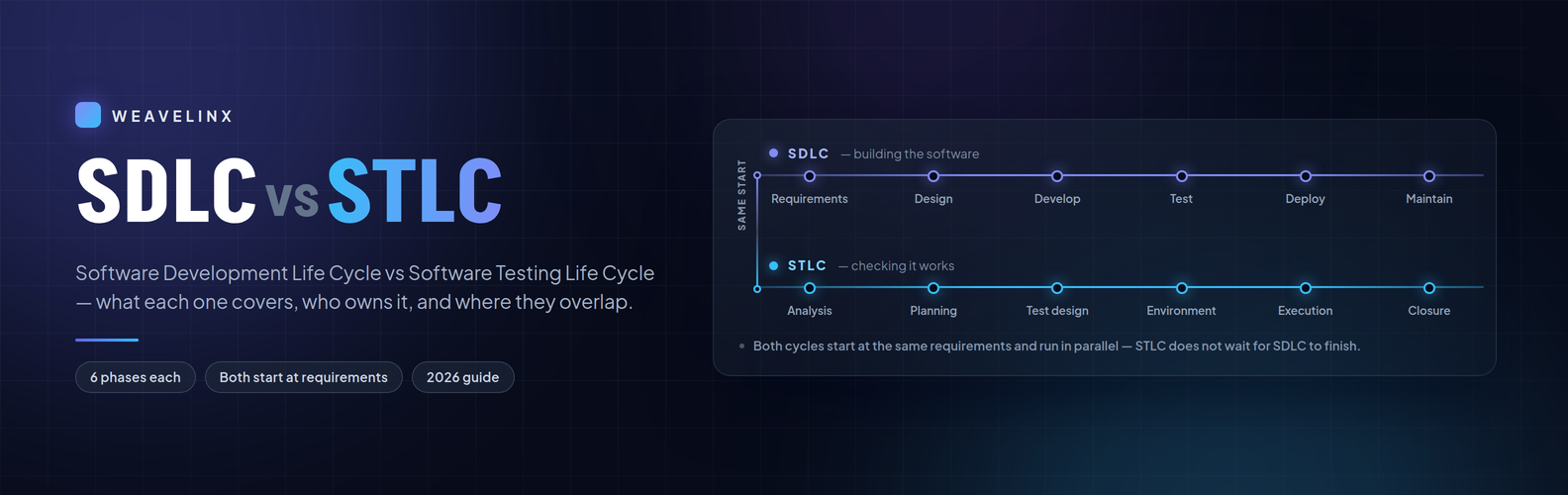
The SDLC is the full process of building software, from first idea to ongoing support. Most guides list six phases:
- Requirement analysis — work out what the software must do
- Design — plan the architecture, database and screens
- Development — write the code
- Testing — check the build works
- Deployment — release it to users
- Maintenance — fix, patch and improve
Each phase produces something you can point at: a requirements document, an architecture diagram, source code, deployment scripts.
Testing is only one box out of six. That is where the confusion starts.
What Is the Software Testing Life Cycle (STLC)?
The STLC is the process a QA team follows to test software properly. It is not a single phase. It is its own cycle running alongside the build:
- Requirement analysis — decide what is testable, and where the risk sits
- Test planning — set the scope, tools, people and timeline
- Test design — write the test cases and test data
- Test environment setup — build a place that behaves like production
- Test execution — run the tests and log defects
- Test closure — report coverage, sign off, record lessons
STLC has its own deliverables: a requirement traceability matrix, a test plan, test cases, defect reports, a closure report.
Why Every Guide Lists a Different Number of Phases
Search this topic and you will find five phases, six, seven and eight. Nobody is lying. Teams split the same work differently. Some break out defect tracking. Some fold reporting into execution.
The count does not matter. The activities do.
Software Development Life Cycle vs Software Testing Life Cycle: The Real Differences
The software development life cycle vs software testing life cycle difference is scope. SDLC covers the whole build — requirements, design, development, testing, deployment and maintenance. STLC covers testing alone — analysis, planning, test design, environment setup, execution and closure. STLC runs inside and alongside SDLC, not after it.
Put simply: SDLC asks how do we build this? STLC asks how do we test this?
| SDLC | STLC | |
| Scope | The whole build | Testing activities only |
| Goal | Ship working software | Find defects before users do |
| Owner | Product, BA, design, engineering | QA engineers and test leads |
| Starts | At requirements | At requirements |
| Ends | With deployment and maintenance | With test closure and sign-off |
| Key outputs | BRD, SRS, architecture, code | RTM, test plan, test cases, defect reports |
| Measured by | Delivery against scope | Coverage, defect density, release readiness |
Look at the Starts row. Both cycles begin at the same point.
You will read that STLC “comes after” SDLC. That was true in waterfall. It is not true now.
ISTQB is the global testing certification body. Its Foundation Level syllabus is blunt: “Test analysis and design for a given test level begins during the corresponding development phase.”
The industry has moved with it. 71.5% of teams now include QA in sprint planning, per the 2026 QA trends report.
How SDLC and STLC Overlap in Practice
Here is what each side is doing during the same week.
| SDLC phase | Developers | Testers |
| Requirements | Work out what to build | Work out what to test, flag risky areas |
| Design | Draw the architecture | Draft test scenarios, plan the approach |
| Development | Write the code | Write test cases, build the test environment |
| Testing | Fix what QA reports | Run tests, log and track defects |
| Deployment | Release the build | Run final checks and smoke tests |
| Maintenance | Ship patches | Regression test so fixes break nothing |
The old V-Model draws this as a literal V. Requirements pair with acceptance testing, architecture with integration testing, module design with unit testing.
This holds whether you build in-house or hire out. Our software development services run QA inside the build. If you are hiring out, our software development outsourcing process guide covers how to keep delivery under control.
What It Costs to Skip the Testing Life Cycle
A defect gets more expensive the longer it survives. The widely cited cost curve looks like this:
| Where the bug is found | Relative cost | Typical fix time |
| Requirements | 1x | 30 minutes |
| Design | 5x | 2 hours |
| Development | 10x | 4 hours |
| Testing | 15x | 8 hours |
| Production | 100x | 2–5 days |
Treat those multipliers as a shape, not a measurement. The underlying data is decades old.
The scale is real, though. In 2002, NIST priced inadequate software testing at $59.5 billion a year to the US economy. CISQ later put the cost of poor software quality at $2.41 trillion in 2022.
Knight Capital is the version you can picture. A deployment reached seven of eight servers, and no process caught it. That was not a coding failure. It was a release and testing failure — exactly the gap between SDLC and STLC.
QA Process Audit
Not sure your QA process is doing its job?
Send us your setup. We will tell you which STLC phases you are running, which you are missing, and what that gap costs.
How This Works in Agile, DevOps and AI-Assisted Teams
In waterfall, the two cycles ran back to back. Build everything, then test everything.
In Agile they run together, inside each sprint. In DevOps they merge further. 89.1% of teams now run CI/CD, per the same report, so testing can run on every commit. The phases have not disappeared. They are compressed and repeated.
What Changes When AI Agents Write the Code
This shift makes STLC more important, not less. AI writes code fast. It also writes more problems. CodeRabbit studied 470 open-source pull requests. AI-co-authored PRs carried 10.83 issues each, against 6.45 for human-only — roughly 68% more.
Speed alone does not help. DORA research found rising AI adoption lined up with drops in both throughput and stability. The researchers’ read: AI amplifies whatever process you already have.
It cuts the other way too. The same QA trends report links GenAI-assisted testing to 31–45% better software quality. The process decides which effect wins.
Forrester’s conclusion is the one to remember: testing becomes more important in an agentic SDLC, not optional.
Quality Assurance
Shipping AI-assisted code without a QA layer?
If your team has sped up but your defects have too, that is a process gap. We will show you where the checks belong.
Which STLC Phases Teams Actually Skip
Textbook diagrams show six neat boxes. Real teams do not work that way. Testers on r/QualityAssurance were asked which steps get skipped, and a few phases came up repeatedly:
- Always done: requirement analysis, environment setup, execution and the defect tracking inside it
- Always done, but short: test planning — as cheap as possible, as detailed as needed
- Often compressed: test design, frequently merged into execution
- Often ceremonial: test closure, sometimes just moving a ticket forward
Note the awkward bit: test design gets cut most, and you can least afford to lose it.
Requirement analysis and test design are the two to protect. Skip analysis and you test the wrong things. Skip design and you find only the bugs you thought of.
One line from that thread sums it up. Nobody wants to pay for planning — until something breaks, and everyone asks why it was skipped.
That is the discipline behind lean software development. Defects are waste, and waste is cheapest to remove early.
Frequently Asked Questions
What is the difference between SDLC and STLC?
SDLC covers the whole build, from requirements to maintenance. STLC covers testing alone, from test analysis to test closure. STLC runs inside and alongside SDLC, not after it.
Is STLC part of SDLC?
Yes and no. Testing is one SDLC phase, so STLC sits inside it. But STLC also runs in parallel across every other phase, with its own team, plan and deliverables.
Does STLC start after development is finished?
No. Both cycles begin at requirement analysis. Testers plan coverage before code is written. Waiting until development ends is the most expensive way to test.
Do AI coding tools remove the need for a testing life cycle?
No. AI-assisted pull requests carry more issues than human-written ones, so testing gets more load, not less. The tester’s job shifts from scripting to setting quality goals and supervising automated checks.
Where That Leaves You
SDLC and STLC are not competitors. They are two lanes of the same road.
SDLC answers what are we building? STLC answers does it actually work? Run one without the other and you either ship untested software or test something nobody needed.
Teams that get this right start both cycles on day one. QA sits in requirements meetings. Test design is real work, not paperwork. You can see the results in our portfolio of client projects, including DeskBilling, our own invoicing product with 5,000+ downloads.
Tell Us What You Are Building
See what your development process is missing
Need a full development team or a QA layer over existing work? Let us help you plug the gaps.