Redux started as a demo. In 2015, Dan Abramov built it for a conference talk about hot reloading and time-travel debugging. A year later, he wrote a post called You Might Not Need Redux.
So the debate is almost as old as Redux itself.
Most guides on Redux vs Context API still say the same thing: Context for small apps, Redux for big ones. That rule is too simple. Some top-ranking pages even get the reason backwards.
This guide gives you the real difference, working 2026 code and a simple way to choose. It comes from a team that builds React dashboards for a living.
Redux vs Context API: Which Should You Use?
Use Context API to pass data that rarely changes, like theme, language or the logged-in user. Use Redux Toolkit when many components read and update the same state often. Context moves data down the component tree. Redux manages how that data changes. Many production apps use both.
What Is the Context API in React?
The Context API is a built-in React feature that passes a value to deeply nested components. You skip passing props through every level. You create a context, wrap your app in it, and read it with the useContext hook.
It solves a problem called prop drilling. Without Context, a value at the top must pass through every component in between. That gets messy fast.
Context shipped in its current form in React 16.3, in March 2018. It costs nothing to add, because it is part of React.
What Is Redux, and What Is Redux Toolkit?
Redux is a library that keeps your app’s shared state in one central store and changes it only through actions. Every change is a plain object describing what happened. A reducer function decides how the state updates.
Redux Toolkit (RTK) is the official, modern way to write Redux. It cuts most of the setup code that gave Redux its “boilerplate” reputation. The Redux team now says any new Redux code should use Redux Toolkit. They describe the old core-only style as obsolete.
So when this article says “Redux,” read it as “Redux Toolkit.” Nobody should start a project with 2016-style Redux today.
Is Context API a State Management Tool?
No. Context is a way to deliver a value, not a way to manage it. It stores nothing on its own. The state still lives in useState or useReducer, and Context passes it down.
Redux maintainer Mark Erikson makes this point in his widely shared post on why Context is not a state management tool. He describes Context as “a form of Dependency Injection.”
Here is a simple way to picture it. Context is the delivery pipe. useReducer or Redux is the warehouse. You can pair Context with useReducer to get something that looks like Redux. But it does not behave like Redux, as you will see below.
What Is the Difference Between Redux and Context API?
Context only passes a value. Redux manages state changes and lets each component subscribe to just the data it needs. That second part decides performance as your app grows.
| Context API | Redux Toolkit | |
| What it is | Built-in value delivery | State management library |
| Install | Nothing, part of React | @reduxjs/toolkit + react-redux |
| Setup | A few lines | A store and slices |
| Who re-renders on a change | Every component that reads the context | Only components whose selected data changed |
| Debugging | React DevTools | Redux DevTools, with action history and time travel |
| Async logic and middleware | Write your own | Built in (thunks, listeners, RTK Query) |
| Works outside React | No | Yes |
| Best for | Theme, language, auth user, feature flags | Large shared state that changes often |
What Do Redux and Context API Look Like in Code?
Both use a provider at the top and a hook in the component. Redux Toolkit adds a store and lets components select a slice of it. Here is the same counter built both ways, on React 19 and Redux Toolkit 2.
The Context version
This follows the pattern in React’s own docs: one context for the state, one for the dispatch function.
// CountContext.jsx (React 19)
import { createContext, useContext, useReducer } from 'react';

const CountContext = createContext(0);
const CountDispatchContext = createContext(null);

function countReducer(count, action) {
  switch (action.type) {
    case 'increment':
      return count + 1;
    default:
      return count;
  }
}

export function CountProvider({ children }) {
  const [count, dispatch] = useReducer(countReducer, 0);
  return (
    // React 19: render the context directly, no .Provider needed
    <CountContext value={count}>
      <CountDispatchContext value={dispatch}>{children}</CountDispatchContext>
    </CountContext>
  );
}

export function Counter() {
  const count = useContext(CountContext);
  const dispatch = useContext(CountDispatchContext);
  return (
    <button onClick={() => dispatch({ type: 'increment' })}>
      Clicked {count} times
    </button>
  );
}
The Redux Toolkit version
// store.jsx (Redux Toolkit 2.x, React-Redux 9.x)
import { configureStore, createSlice } from '@reduxjs/toolkit';
import { Provider, useSelector, useDispatch } from 'react-redux';

const counterSlice = createSlice({
  name: 'counter',
  initialState: { value: 0 },
  reducers: {
    // Looks like mutation, but RTK uses Immer to keep it immutable
    increment: (state) => {
      state.value += 1;
    },
  },
});

export const { increment } = counterSlice.actions;
export const store = configureStore({
  reducer: { counter: counterSlice.reducer },
});

export function Counter() {
  // Re-renders only when state.counter.value changes
  const count = useSelector((state) => state.counter.value);
  const dispatch = useDispatch();
  return (
    <button onClick={() => dispatch(increment())}>
      Clicked {count} times
    </button>
  );
}

export default function App() {
  return (
    <Provider store={store}>
      <Counter />
    </Provider>
  );
}
Watch out for old tutorials. If a guide uses createStore or connect(), it is out of date. React-Redux officially deprecated connect in May 2026 in favour of hooks.
Is Context API Faster Than Redux?
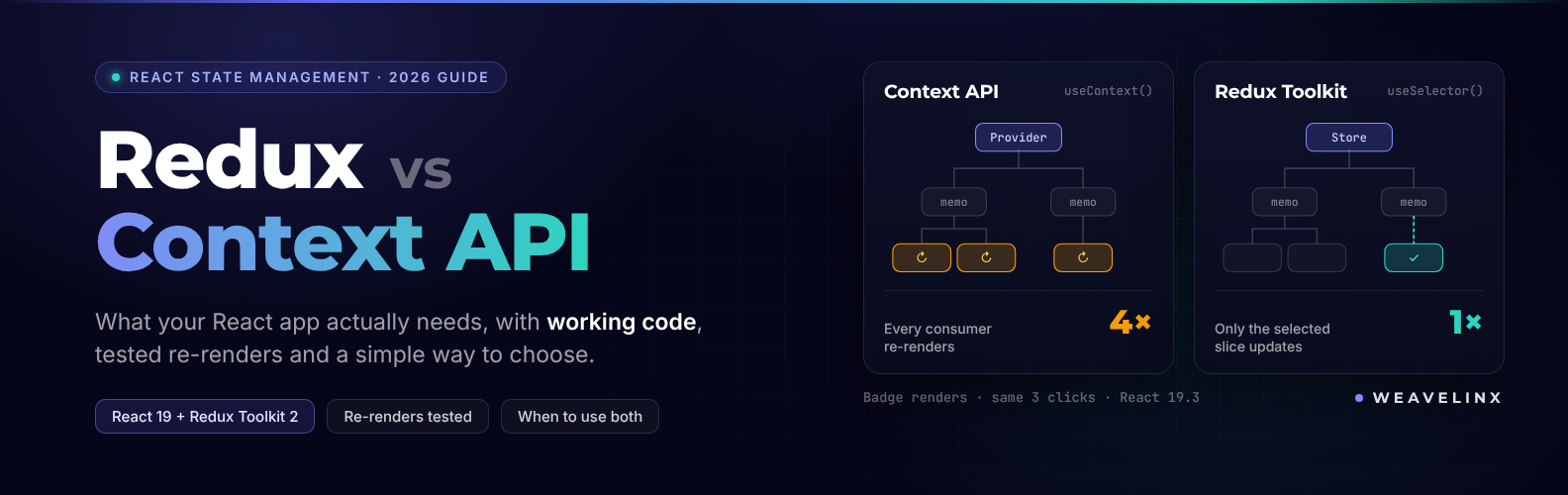
No. Neither is faster by default, but Context re-renders every component that reads it whenever its value changes. Redux re-renders only the components whose selected data actually changed. Some popular articles claim the opposite. They are wrong.
We tested this ourselves on React 19.3 and Redux Toolkit 2.13. We built a small “user badge” that only shows a name. Then we changed an unrelated counter three times.
- With Context, the badge read one shared context object. It re-rendered 4 times: once on load, then on every click. It even sat behind a memoized parent.
- With Redux, the badge selected only state.user.name. It rendered once and ignored the counter.
// Context: the badge re-renders when count changes, even though it only uses user
const { user } = useContext(AppContext);

// Redux: the badge subscribes to one field and skips unrelated updates
const name = useSelector((state) => state.user.name);
For a theme toggle, this does not matter. For a live dashboard with fifty widgets, it matters a lot. Check your own app with the React DevTools Profiler.
Does React Compiler Fix Context Re-renders?
Partly. React Compiler cuts wasted child re-renders. But every component that reads a context still re-renders when it changes. The compiler hit its stable 1.0 release in October 2025. It memoizes components automatically at build time.
It makes Context apps cheaper to run. It does not give Context the per-field subscriptions that Redux has. So treat it as a helpful boost, not a reason to drop selectors.
How Do You Stop Context From Re-rendering Everything?
Split large contexts into smaller ones, keep state and dispatch in separate contexts, and memoize object values. That fixes most problems before you need a library.
- Split by topic. One context for theme, another for the user. A theme change then leaves user components alone.
- Separate state from dispatch. Components that only send actions stop re-rendering on every state change. The code above already does this.
- Use a selector library. use-context-selector adds Redux-style selectors to Context. It gets about 2.4 million weekly npm downloads, which shows how common this problem is.
If you are still fighting re-renders after all that, it is time for a store.
React Development
Is your React app slowing down as it grows?
Our React developers profile the re-renders, fix the state structure and ship the change. Profiles in 48 hours.
When Should You Use Context API?
Use Context API for values that many components read but rarely change. It is the right default when you only need to avoid prop drilling.
Good fits for Context:
- Light or dark theme
- Language and locale
- The logged-in user’s profile
- Feature flags and app settings
Context is also fine for small apps and early MVPs. If you are building an MVP, start with what React gives you. Add a library when the pain is real, not before.
When Should You Use Redux Toolkit?
Use Redux Toolkit when lots of components share state that changes often and the update logic is complex. The official Redux FAQ lists the same signs.
Reach for Redux Toolkit when:
- Many screens read and update the same data, like a cart, filters or live records.
- State changes often, many times a minute or faster.
- Several developers work on the same codebase and need one clear pattern.
- You need to trace exactly what changed and why, using Redux DevTools.
- You need undo, redo or saved history.
Erikson offers a handy rule of thumb. Once your app has more than two or three contexts holding state, consider moving to Redux.
This is common in business software. Think inventory screens, live reports and multi-user dashboards. Our SaaS and ERP development work lives here. One example is a real-time manufacturing ERP we built in React. It cut the client’s production planning cycle from 5 days to 18 hours. Dashboards like that also need the right charts, so see our guide to chart libraries for React projects.
Internal Tool Development
Build a custom internal dashboard or tool with our team
Tell us what your screens need to do. We will propose a state setup, technology stack, and timeline before anyone writes code.
Can You Use Context API and Redux Together?
Yes, and most large React apps do. Context handles slow-changing app settings. Redux Toolkit, or a lighter store, handles busy shared state. They do not conflict.
The better question is: what kind of state is this? Sort it first, then pick the tool.
| Type of state | Example | Best tool |
| Local UI state | A form input, an open modal | useState |
| App settings | Theme, language, logged-in user | Context API |
| Server data | Products, orders, API results | TanStack Query or RTK Query |
| Shared client state | Cart, filters, multi-step workflows | Redux Toolkit or Zustand |
That third row is the big one. Much of what teams once put in Redux was really API data. Tools like TanStack Query now cache it, refetch it and track loading states for you.
This is how our own React team works. For state, we pick Zustand or Redux Toolkit based on complexity. For data fetching, we use React Query or SWR. Context covers the settings layer.
Is Redux Still Relevant in 2026?
Yes. Redux is still widely used, but its job is smaller than it used to be. It is now the tool for complex shared client state, not the default home for everything.
The download numbers show both sides. In the first week of October 2026, npm recorded:
| Package | Weekly downloads |
| @tanstack/react-query | 65.8 million |
| zustand | 60.8 million |
| redux | 45.6 million |
| @reduxjs/toolkit | 32.6 million |
Source: npm downloads API, 2–8 October 2026. Counts include automated builds and installs pulled in by other packages, so treat them as direction, not market share.
Tens of millions of weekly downloads is not a dead library. The team keeps shipping, too. In May 2026 they deprecated the old connect API. They also added guidance files for AI coding assistants to Redux Toolkit 2.12.
What Replaced Redux in React?
Nothing replaced Redux outright, but its old jobs split across three tools. Server data moved to TanStack Query. Simple shared state moved to lighter stores like Zustand. Settings stayed in Context.
Zustand now gets more weekly downloads than Redux. It offers selectors, like Redux, with far less setup. That makes it a strong middle option between Context and Redux Toolkit.
Redux Toolkit still wins when you want strict structure, strong DevTools and one shared pattern across a large team.
Frequently Asked Questions
Should I use Redux or Context API?
Use Context for values that rarely change, like theme or the logged-in user. Use Redux Toolkit when many components share state that changes often. Many apps use both, each for its own kind of state.
Is Context API faster than Redux?
No. Context re-renders every component that reads it when the value changes. Redux re-renders only components whose selected data changed. For frequently changing state, Redux usually wastes fewer renders.
Is Context API a replacement for Redux?
Not fully. Context passes data, but it does not manage it. Paired with useReducer, it covers small and medium apps. It lacks Redux’s selectors, middleware and DevTools history.
What is the difference between Redux and Redux Toolkit?
Redux Toolkit is the official modern way to write Redux. It uses the same ideas with much less code. It also builds in good defaults, such as safe immutable updates and DevTools setup.
Should I pick Zustand or Redux Toolkit?
Choose Zustand for a small, fast store with little setup. Choose Redux Toolkit for large teams that need strict patterns, rich debugging or built-in data fetching through RTK Query.
Is Redux for frontend or backend?
Redux is mainly used for frontend state in React apps. Its core is plain JavaScript, so it can run anywhere JavaScript runs. In practice, though, it is a frontend tool.
Pick the Tool That Matches the State
The honest summary is short. Context API delivers data. Redux Toolkit manages data that changes a lot. Neither is “better.” They solve different problems.
Start with useState and Context. Move server data to a query library. Add Redux Toolkit or Zustand when shared state starts to hurt. Planning for mobile too? Read our guide to mobile app development with React.
Building or untangling a React app?
Tell us what it does and where it hurts. We will recommend a state setup and explain the trade-offs in plain language, even if the answer is that you don’t need us yet.