Ask three Pune agencies to quote your iPhone app and you will get three very different numbers. One says ₹80,000. One says ₹6 lakh. One will not give a figure until you sit through a demo.
None of them are lying. They are quoting different things, and almost nobody explains the difference.
This guide gives real numbers for iOS app development services in Pune. Costs in rupees, honest timelines, and the questions to ask before you sign. Weavelinx is based here, so these are local rates, not a global average.
What iOS App Development Services in Pune Include
Most agency pages list twenty services. A real iOS build has five parts.
| Part | What actually happens |
| Custom app development | Native builds in Swift and SwiftUI, or React Native when one codebase should serve both stores |
| UI/UX design | Screens built to Apple’s Human Interface Guidelines, not a website squeezed onto a phone |
| Apple ecosystem work | CloudKit for sync, PassKit for Apple Pay, MapKit for location, SiriKit for voice |
| QA and testing | Automated tests plus real-device testing, then a TestFlight beta before launch |
| Launch and upkeep | App Store submission, store listing, and updates as iOS changes |
That last one is where budgets break. Plan for 15–25% of your build cost every year to keep the app running. Apps that skip maintenance fail quietly when iOS updates.
How Much Does an iOS App Cost in Pune?
This is the question Google shows most often on this search, so here is a straight answer.
| App type | Pune price range | Typical timeline |
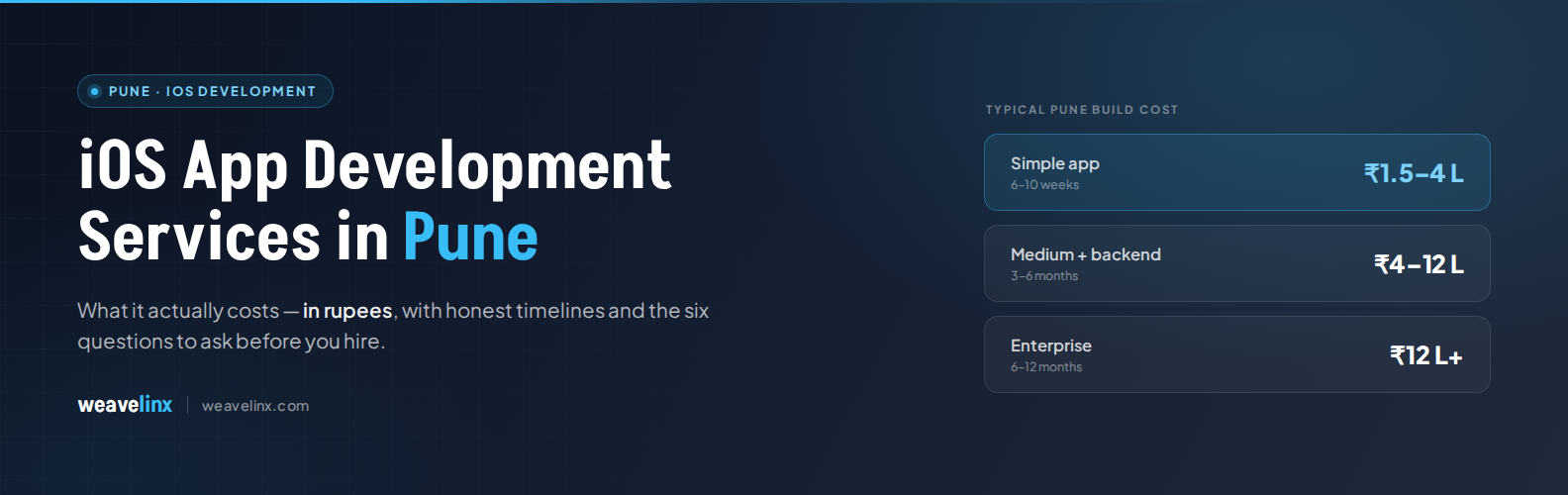
| Simple app, few integrations | ₹1.5–₹5 lakh | 6–10 weeks |
| Medium app with backend and payments | ₹5–₹12 lakh | 3–6 months |
| Complex or enterprise app | ₹12–₹50 lakh+ | 6–12 months |
If you would rather hire developers than buy a project:
| Level | Hourly | Monthly, dedicated |
| Junior | ₹800–₹1,500 | ₹50,000–₹1,00,000 |
| Mid-level | ₹1,500–₹3,500 | ₹1,00,000–₹2,50,000 |
| Senior | ₹3,500–₹6,000+ | ₹2,50,000–₹4,50,000+ |
Pune rates run roughly 60–70% below Western markets for the same skill. That is the real reason work lands here.
What Actually Moves the Number
Integrations, not screens. The top answer in a Reddit costing thread put it well: screen count tells you nothing about build time. Payments, live chat, maps and offline sync do.
Backend. Ask whether hosting is in the quote. It runs ₹12,000–₹1,60,000 a month depending on how much media you serve.
Compliance. Health or payments data means slower, more careful work.
Who writes the code. A ₹6,000-an-hour senior and a ₹800-an-hour junior will both finish. Only one leaves you a codebase you can build on.
A ₹80,000 quote is not automatically a scam. It usually means a small scope, a solo developer, or a template. Sometimes that is right. Just know which you are buying.
Swift, Flutter, React Native or Kotlin? How We Choose
Most agencies push whichever stack they staff. We would rather tell you when ours is the wrong call.
There are five sane ways to build an iPhone app in 2026. Here is when each one wins.
| Option | Best for | Watch out for |
|---|---|---|
| Native Swift + SwiftUI | Camera, augmented reality, health sensors, Apple Watch. First access to new iOS features | Two codebases if you also need Android |
| React Native + Expo | Teams who already know React. Expo handles builds, app-store submission and over-the-air updates | Version upgrades can swallow weeks |
| Flutter | Identical UI on both stores. Animation is smooth since the Impeller engine landed | Dart is a smaller hiring pool in Pune than JavaScript |
| Kotlin Multiplatform | Sharing business logic while each platform keeps real native UI | Younger ecosystem. Your team needs Kotlin |
| Ionic / Capacitor | Turning an existing web app into a mobile app quickly. Portals, admin panels, content apps | It runs in a webview. Heavy animation and 3D struggle |
What developers actually use. In a June 2026 survey of 404 iOS developers, 68% lead with SwiftUI. Around 37% use or are exploring Flutter, 29% use React Native, and 16% are evaluating Kotlin Multiplatform.
Kotlin Multiplatform is no longer experimental. It has been stable since 2023, and Netflix, McDonald’s and Cash App run it in production. It suits teams that want shared logic without giving up a native feel.
Capacitor is the quiet money-saver. If you already have a working web app, wrapping it is the fastest route to the App Store. Just be honest about the ceiling. It is a browser in a native shell.
The honest trade-off across all five is upkeep. Cross-platform saves money now and moves some of that cost to upgrade time later. We scope this in week one, before anyone writes code.
Still deciding how much to build? Start with an MVP and let real users choose the next feature.
How to Choose an iOS App Development Company in Pune
Search this and you will find dozens of local agencies with near-identical pages. Six questions separate them.
- Will I own the source code and the developer account? The answer should be an immediate yes, in writing.
- Who exactly writes my code? Ask for names and seniority, not a team size.
- What is your App Store approval record? Anyone who has shipped will know. Anyone who hasn’t will change the subject.
- Is backend hosting inside this quote? A cheap quote that excludes it is not cheap.
- What happens after launch? Get the maintenance rate before you start, not after.
- Can I speak to a client you shipped for? In Pune, you can usually meet them.
That last point is the real local advantage. You can visit the office, meet the developers, sit in a review. Distributed teams work fine. Proximity just shortens every hard conversation.
Quote Comparison
Comparing Pune Agencies?
Bring us your other quotes. We will give you an honest breakdown of where ours sits and what the difference buys you.
Why One in Four App Submissions Gets Rejected
Nobody selling iOS app development services enjoys this statistic.
Apple’s 2025 App Store Transparency Report shows 2.09 million rejections from 9.1 million submissions. Roughly one in four. Apple also removed 166,899 apps and shut 193,035 developer accounts.
The top reason is not legal or design. It is performance and completeness — crashes, missing information, broken links, placeholder content. Privacy problems come second.
Developers on r/iosdev treat a first bounce-back as normal. Some wait 10–15 days for a decision. Others clear review in two.
What lowers the risk is dull work. Real-device testing, a complete privacy manifest, a working TestFlight build, and store listing copy written before submission day. We treat review as a milestone with an owner, not a formality.
The April 2026 Rule Every App Owner Should Check
If your app has not shipped an update since spring, check this today.
Apple’s upcoming requirements for App Store submissions changed on 28 April 2026. Every build uploaded now needs Xcode 26 and the iOS 26 SDK. An older build is rejected on upload — even a one-line bug fix.
Two things people get wrong:
- It applies to the build, not your users. Customers on iOS 16 and 17 are unaffected.
- Your interface may shift on its own. System components pick up Apple’s new Liquid Glass styling on iOS 26 devices without any change from you.
Old APIs like UIWebView now fail the build instead of warning. Third-party analytics and ad libraries need current versions too.
If that is your app, the upgrade is short and well defined. It is the cheapest problem on this page to fix.
Is an iOS App Still Worth Building in 2026?
New iOS app launches jumped 89% in a single year, according to App Store data Appfigures reported in April 2026. AI coding tools are the likely reason. Building got easier. Standing out did not.
The money still favours Apple. iOS runs on about a third of the world’s phones. It still earned $90.6 billion against Google Play’s $52.3 billion in 2025.
In India the gap is sharper than the headline. iPhone hit a record 9% of shipments in 2025. Meanwhile the premium segment above ₹30,000 grew 15% and is now 23% of the market. If your customers buy premium phones, they are on iOS.
Frequently Asked Questions
How much does it cost to develop an iOS app in Pune?
Roughly ₹1.5–₹4 lakh for a simple app and ₹4–₹12 lakh for a medium one with a backend. Enterprise work starts around ₹12 lakh. Integrations and compliance move the number far more than screen count.
How long does an iOS app take to build?
Six to ten weeks for something simple, three to six months for an app with a real backend. Discovery and design usually take the first three to four weeks.
Will I own the source code?
Yes. You own the repository, the App Store listing and the developer account. We hand everything over and document it.
Do you handle App Store submission?
We submit for you and answer Apple’s questions if they come back. The store-wide rejection rate is 23%, so we plan for a round of feedback rather than hoping for none.
Can I meet your team in Pune?
Yes. We are based here, and we prefer it. Sprint reviews go better face to face.
Build It Once, Properly
Getting an iPhone app built in Pune is easy. Getting one that clears Apple’s review and holds its users is harder. Keeping it working after the next iOS release is the actual job.
Weavelinx builds native iOS apps in Swift and SwiftUI, and cross-platform apps in React Native when that fits better. We also shipped DeskBilling, our own desktop billing product. So we have been on the receiving end of our own process.
Hiring outside your team for the first time? Read how our software development outsourcing process works first, and see the full range of our software development services.
iOS App Development
Ready to Scope Your iOS App?
Tell us what you want to build. We will provide a plan, timeline, and quote in rupees—or tell you if we are not the right fit.