In 2012, Mark Zuckerberg said Facebook’s biggest mistake was betting too much on HTML5 rather than native. He said the company burned two years on it.
Fourteen years later, the argument is still running. And it just moved again.
This guide covers native app vs hybrid app without the sales pitch. Real definitions, real examples, real costs. One thing up front, because almost nobody says it: Weavelinx builds hybrid and cross-platform apps. That is where most business apps belong. So we will also tell you when yours does not, and when native is the right call.
Native App vs Hybrid App: The Short Answer
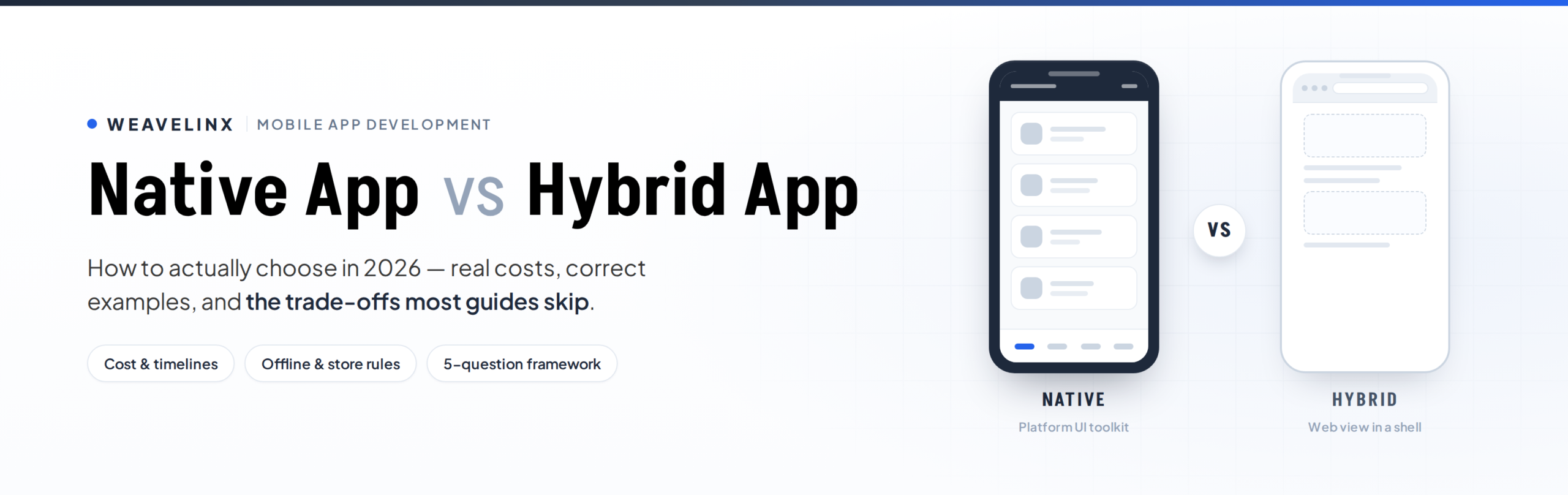
A native app is built separately for each platform using that platform’s own tools. Swift for iOS, Kotlin for Android. A hybrid app wraps a web app inside a native shell, so one codebase runs on both. Native gives you the best performance and platform feel. Hybrid gives you lower cost and faster launch.
Here is how they compare, dimension by dimension.
| What matters | Native wins | Hybrid wins |
| Raw performance | ✅ | |
| Platform look and feel | ✅ | |
| Deep hardware access | ✅ | |
| Build cost | ✅ | |
| Time to launch | ✅ | |
| One team instead of two | ✅ | |
| Updating both apps at once | ✅ |
Neither one is winning the market. Native apps held about 52.3% of mobile app development revenue in 2025, according to SNS Insider’s market estimate. Hybrid is the fastest-growing segment at roughly 18.2% a year.
Both are healthy. The question is which fits your app.
“Hybrid App” Gets Used for Four Different Things
This is where most articles fall apart. The word “hybrid” gets used for four technologies that work nothing alike.
| Approach | How the screen is drawn | What gets shared | What that means |
| Native (Swift, Kotlin) | The platform’s own UI toolkit | Nothing. Two separate apps | Highest ceiling on speed and polish, highest cost |
| Capacitor / Ionic | The phone’s built-in browser view | Everything, including your web code | True hybrid. Lowest cost, fastest to launch |
| React Native (usually via Expo) | Real native views, driven by JavaScript | UI and logic | Looks native, because it is native UI |
| Flutter | Its own rendering engine | UI and logic | Identical pixels on both platforms |
| Kotlin Multiplatform | Native UI, shared business logic | Logic only | Native feel, one logic layer |
Cordova, the older WebView runtime, is now legacy. Capacitor has replaced it for new builds. And most new React Native projects start with Expo, which React Native’s own documentation now recommends.
Read the React Native row again. React Native does not run inside a browser. It renders genuine iOS and Android components.
Amazon’s own explainer gets this right. AWS defines hybrid apps as native applications with a web browser embedded inside them. Ionic, who build the leading hybrid runtime, say the same thing.
By that definition, React Native and Flutter are not hybrid at all. They are cross-platform. Different thing.
What hybrid and cross-platform have in common is the part that matters for your budget: shared code. Write a feature once and it ships on iOS and Android. Hybrid goes one step further, because it can reuse code from your existing web app too. That is why it is usually the cheapest route to both stores.
Native App Examples and Hybrid App Examples (Most Lists Are Wrong)
Search this topic and you will find example lists that contradict each other. One popular guide calls Instagram native. Another calls it hybrid. Same search results page.
It gets worse. Several articles list Airbnb as a hybrid app. Airbnb publicly stopped using React Native in June 2018 and explained why in detail. That is eight-year-old news being repeated as current fact.
So here is a more careful version.
Native: WhatsApp, Spotify, Google Maps, Gmail. Yes, WhatsApp is a native app.
Cross-platform, and openly documented as such: Discord and Bloomberg run on React Native. Shopify’s apps did too, until Shopify announced a move back to native in September 2026.
Hybrid, in a WebView: mostly internal tools, event apps, catalogues and content apps. Few are household names, which is the honest answer to “name a famous hybrid app.” Our own Broker App, built in Ionic, sits in this category.
One warning about every list like this, including ours. Big apps change quietly, and a single screen can use a different technology from the rest. Treat any example list as a snapshot, not a fact of nature.
One honest note on that Airbnb story. Their “failed” React Native project ran to 80,000 lines of code across 220 screens. And when they surveyed their own engineers at shutdown, 74% said they would still consider React Native for new projects. The case study everyone cites as proof cross-platform fails has that footnote inside it.
What Changed in 2026: Shopify Moved Back to Native
This is the newest development in the native app vs hybrid app debate.
On 10 September 2026, Shopify published Native is now the future of mobile at Shopify. They are moving their apps from React Native back to Swift and Kotlin.
Their reason is not performance. It is AI. In their words, agents now handle enough of the implementation, translation, testing and review work. Building twice is no longer the deciding factor it was in 2020.
The numbers are striking. Shopify rebuilt the Shop app natively in 12 weeks, from proof of concept to App Store. Their merchant app runs to 300+ screens, plus widgets, an Apple Watch app and Siri Shortcuts.
Now the parts that did not make the headlines.
Shopify still calls React Native “an excellent framework” that served them well for six years. But they are stepping back from it. FlashList, a React Native library with around 2 million weekly downloads, gets critical fixes while Shopify looks for a new long-term steward. React Native Skia will be forked by its original creator. Restyle is being archived.
And developers reacting to the news made a sharper point. Shopify took more than five years to migrate to React Native, and they still use WebViews inside their apps for some functionality.
That last detail matters more than the headline. Almost no real app is purely one thing. Big apps mix native screens, cross-platform screens and WebViews, based on what each screen needs.
One more thing worth saying plainly. Shopify’s maths works because of what they already had. Two mature native teams. Five years of AI tooling investment. Custom testing infrastructure they built themselves. If you are a 30-person company shipping your first app, none of that is on your side.
Here is the part worth taking away. Shopify’s argument is that AI coding tools made building twice cheap enough. But those same tools make building once cheaper still. A small team using AI on a shared codebase gets the saving without needing two native teams or Shopify’s in-house testing system. For most businesses, the Shopify news makes hybrid and cross-platform more attractive, not less.
Native vs Hybrid App Development Cost
Very few articles publish numbers. One agency does, and its figures are widely quoted: $50,000 to $150,000+ per platform for native, against $30,000 to $75,000+ total for hybrid. Timelines of 3 to 6 months per native platform, versus 2 to 4 months total.
Treat those as one company’s published estimates. They carry no source.
Here is the more useful framing, in rupees. Weavelinx’s enquiry form runs from under ₹1 lakh to ₹15 lakh+. A standard business app with a backend and a few integrations typically sits in the middle of that range. A hybrid build sits lower, because more of the code is shared, and sometimes reused from a web app you already have. What moves the number is not screen count. It is integrations: payments, offline sync, maps, chat, live data.
Two things almost every quote leaves out.
The second codebase. Native means two apps, two release cycles and two test suites. That cost is ongoing, not one-off.
Maintenance. Budget for it yearly. Apps that skip it break quietly when iOS or Android updates.
A real example from our own work. Our Broker App is a hybrid app built in Ionic. It connects to a real-estate broker’s WordPress site: the agent scans a QR code on the desktop, logs in, and gets the site’s CRM and property listings on their phone. One codebase serves both platforms, and the data stays on the broker’s own server. Building it hybrid meant we reused the web logic we already had instead of writing it again twice.
Project Estimates
Want a Number You Can Actually Plan Around?
Send us your feature list. We will come back with a clear, scoped estimate in rupees and an honest timeline.
Will Apple Reject a Hybrid App?
Nobody writing about this keyword mentions the store rules. They should.
Apple’s App Store Review Guidelines include Guideline 4.2, Minimum Functionality. It says your app “should include features, content, and UI that elevate it beyond a repackaged website.”
Guideline 4.2.2 goes further. Apps “shouldn’t primarily be marketing materials, advertisements, web clippings, content aggregators, or a collection of links.”
Google Play runs a similar Spam and Minimum Functionality policy.
So here is the distinction that actually helps you. Hybrid is not risky. Thin is risky.
A hybrid app with real native integrations — push notifications, camera, biometrics, offline storage — ships every single day. A WebView pointed at your website with nothing added is exactly what Apple wrote a rule about.
This is the design question we plan around on every hybrid build. Our Broker App is a WebView app, but it is not a website in a wrapper. It scans QR codes with the camera, handles its own sign-in, and pulls live CRM and listing data through an API. Those are the features that make an app an app in Apple’s eyes. If a proposed hybrid app has nothing like them, we say so before a line of code is written.
Can a Hybrid App Work Offline? Yes, It Can
You will read that hybrid apps need an internet connection. One widely-shared comparison table states it outright.
That is wrong.
Hybrid and cross-platform apps handle offline work routinely. Local SQLite storage, sync queues and conflict resolution are standard practice. Developers shipping production Capacitor apps say the runtime is not the bottleneck.
Field apps are the usual case: sales reps, site visits, warehouses, anywhere coverage drops. The app saves work on the phone and syncs when the connection returns.
Offline-first is an architecture decision, not a native-only feature.
How to Choose: Five Questions
Forget the frameworks for a minute. Answer these.
- Does your app need deep OS features? Home-screen widgets, heavy background processing, game-grade graphics, or brand-new OS APIs. If yes, go native or plan to mix.
- Do you already have a good web app and a web team? Then a hybrid build is the cheapest honest route to both stores.
- Do you need both platforms at once on a fixed budget? Cross-platform, almost always. One team, one codebase, both stores.
- Is this a flagship product or a validation build? Validation builds should not cost two codebases. Scope it as an MVP first.
- Who is maintaining this in three years? Hiring React or JavaScript developers is easier and cheaper than staffing two native teams.
Put your answers together and they point to one of three routes.
| Choose | When | Cost |
| Hybrid (Capacitor / Ionic) | You have a web app or web team, your app is mostly forms, lists, dashboards and data, and you need both stores on a tight budget | Lowest. Most code shared, some reused from the web |
| Cross-platform (React Native, Flutter) | You need a more native feel, smoother animation or more device features, but still one team | Middle. UI and logic shared across both stores |
| Native (Swift, Kotlin) | The app is built around widgets, background processing, game-grade graphics or brand-new OS features | Highest. Two codebases, two teams |
For most small and mid-sized businesses, the first two routes cover the app they need. Shared code is what makes the cost difference: every feature is built once, tested once and updated once, on both platforms.
That is why we build hybrid and cross-platform apps. Not because they win every argument. Because they win this one, for the apps we usually get asked to build.
And when they don’t? We say so. If your app needs native, we will tell you, even if that means pointing you elsewhere.
Honest Advice
Not Sure Which Side You Fall On?
Bring us your requirements and existing quotes. We will give you a straight answer, even if it means we are not the right fit.
Frequently Asked Questions
Which is better, a native app or a hybrid app?
Neither, universally. Native wins on performance, platform feel and deep hardware access. Hybrid wins on cost, speed to launch and maintaining one codebase. Pick based on your features, budget and team.
What are the disadvantages of native apps?
Two codebases, two teams, two release cycles and two sets of tests. Higher build cost and longer timelines. Feature parity between iOS and Android becomes ongoing work.
Is WhatsApp a native app?
Yes. WhatsApp is built natively for iOS and Android.
Is React Native hybrid or native?
Neither, strictly. React Native renders real native components, so it is not hybrid. But it shares one codebase, so it is not traditional native either. The correct word is cross-platform.
Is React Native still relevant in 2026?
Yes. Shopify’s move back to native made headlines, but Shopify still calls React Native an excellent framework and still maintains libraries for it. Cross-platform releases have grown steadily, from 7% of new apps in 2020 to 15% in 2024.
Can a hybrid app work offline?
Yes. Local storage, sync queues and conflict resolution make offline-first hybrid apps completely normal.
Will Apple reject my hybrid app?
Not for being hybrid. Apple rejects apps that are just a repackaged website with no added functionality. Real native integrations clear that bar.
Can I switch from hybrid to native later?
Yes, but budget for it. Shopify rebuilt one app natively in 12 weeks, with an entire engineering organisation behind it.
Pick the One That Fits the App You Are Building
The honest summary is short. Native is better if you need everything the platform can do. Hybrid is better if you need both stores, quickly, on a real budget. Most apps are a mix, including the famous ones.
And be aware of who is telling you. Almost every article on this topic is published by a company that sells one of the answers, and almost none of them say so.
Weavelinx builds hybrid and cross-platform mobile apps from Pune. You can see how we run a mobile build, from wireframes through to launch. If you want to compare paths, read what native iOS development costs in Pune against what a React build really costs.
Need engineers rather than a project team? You can hire hybrid and React Native developers through us.
App Strategy
Ready to Decide Your App Architecture?
Tell us what your app needs to do. We will recommend native, cross-platform, or hybrid and explain trade-offs in plain language.